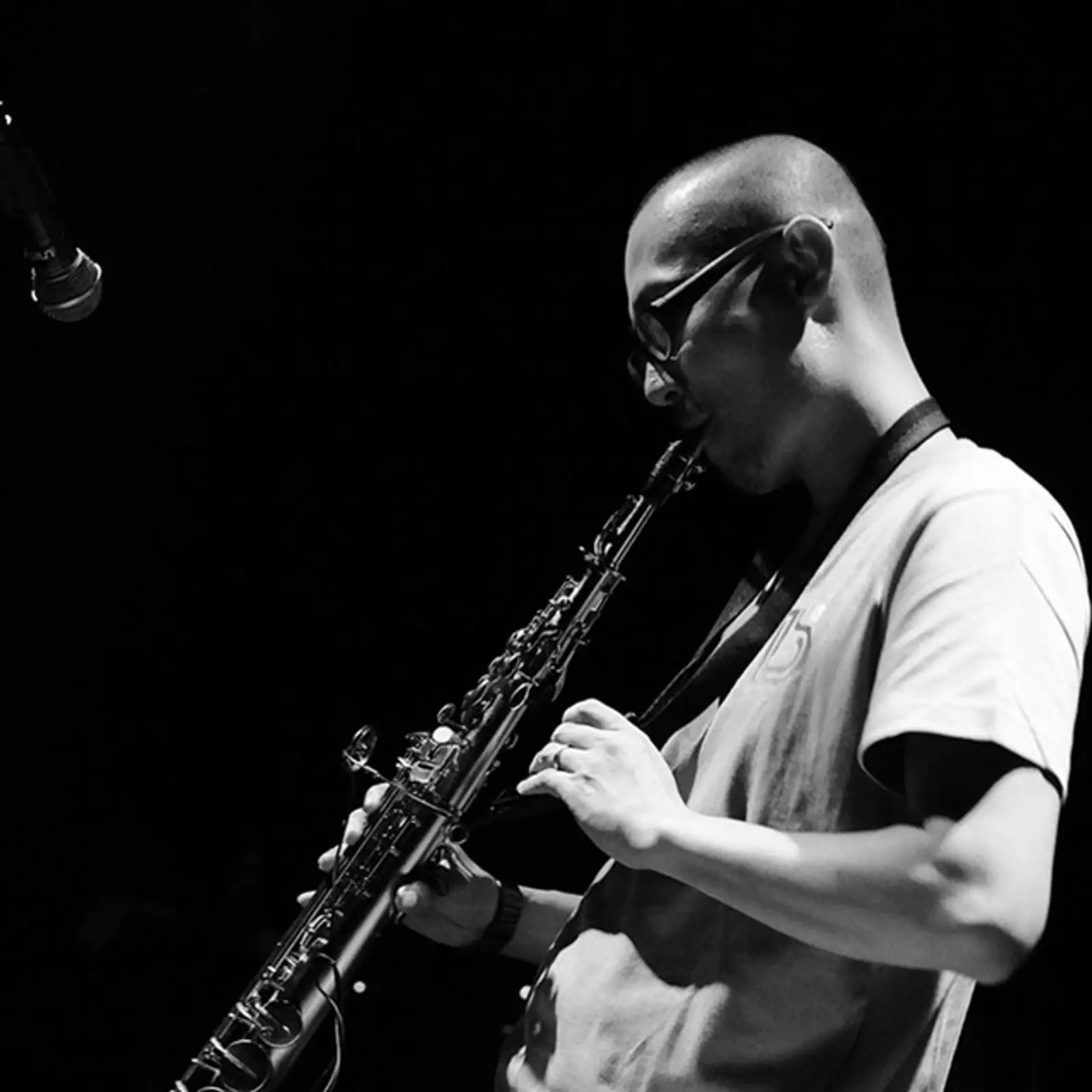
Picture a flute entering a track the way light enters a room through a half-open blind — unhurried, precise, casting just enough illumination to change the feeling of the space without demanding attention. This is the sonic signature of Uyama Hiroto, a Tokyo-based flutist and producer whose body of work occupies a territory so carefully defined that it almost resists description. It is jazz, but not entirely. It is hip-hop, but only in structure and spirit. It is ambient, but too alive for that word to hold it fully. What it is, most accurately, is music that has chosen depth over reach — and has been rewarded, across decades of quiet output, with a devoted audience that finds it the way people find the books that change their lives: not through advertising, but through someone handing them something and saying, listen.
A Sound Built for Stillness
Tokyo's independent music culture has long sustained a particular kind of practitioner — one who operates at the intersection of imported forms and local sensibility, absorbing jazz, soul, and hip-hop not as fashion but as genuine philosophical inheritance. The jazz kissa culture that took root in Japan during the postwar decades established a template for serious, attentive listening that has never fully dissolved. In the city's underground, that spirit mutated across generations, feeding into the beat scenes of the 1990s and early 2000s, where producers began building tracks around the same reverence for sound that had once filled smoky basement listening bars.
Uyama Hiroto emerged from this ecology with artistic instincts that placed him apart from both Western jazz tradition and J-pop commercialism. His music sits at the intersection of acoustic jazz performance, hip-hop production architecture, and ambient texture — a combination that resists easy categorization precisely because none of its components are used decoratively. The flute is a loaded choice. In jazz lineage, it carries the weight of Yusef Lateef's spiritual expansiveness and Roland Kirk's wild, embodied virtuosity. In hip-hop-adjacent production, it is almost never the center of gravity. Uyama made it one, and in doing so claimed a sonic territory that was genuinely his own.
The argument this music makes is not a loud one. It insists, quietly but without apology, that longevity in underground culture is built through craft and consistency — through the accumulation of work rather than the performance of visibility. It is an argument Uyama has been making with every record he has released, and one that his catalogue, considered as a whole, proves convincingly.
The Nujabes Orbit: Collaboration as Apprenticeship
To understand Uyama Hiroto's artistic formation, it is necessary to spend time inside the creative world of Seba Jun — the producer who recorded and released music under the name Nujabes. Nujabes built a sound from jazz samples, boom-bap rhythm structures, and a distinctly Japanese quality of melancholy: music that felt nostalgic without being specific, meditative without being inert. His work on the Samurai Champloo soundtrack brought that aesthetic to an international audience, but the foundation had been built in Tokyo's underground long before any animation commission arrived.
Uyama's contributions to Nujabes' projects were not incidental. His flute work brought a live, breathing quality to productions that might otherwise have remained sealed within their samples — it introduced unpredictability, warmth, and a human presence that deepened the music's emotional register. Where Nujabes constructed layered, textural landscapes from pre-existing material, Uyama's instrument moved through those landscapes like something found there naturally. The collaboration worked precisely because both artists operated with complementary instincts: one building architecture, the other inhabiting it in real time.
The broader Nujabes circle functioned as a loose but genuine creative community — connecting producers, MCs, and instrumentalists outside mainstream industry structures in a way that reflected how Tokyo's independent scenes have always organized themselves: through trust, shared taste, and proximity rather than formal contracts. Uyama moved through this world as a collaborator, live instrumentalist, and conceptual ally. The relationship was formative, but it should not be understood primarily through what came after. Before Nujabes' death in 2010, these collaborations stood on their own terms — as evidence of a thriving creative exchange, not as a precursor to legacy.
After Seba Jun: Grief, Continuity, and the Solo Turn
Nujabes died in February 2010, and the loss reverberated through Tokyo's underground and far beyond it. The international community that had gathered around his music — drawn in through Samurai Champloo, through carefully passed-along playlists, through the particular way his sound met listeners who needed exactly that kind of quiet — mourned with an intensity unusual for an artist who had never sought mainstream attention. His absence created a space that many expected to be filled with tribute records and memorial gestures.
Uyama Hiroto did not make a tribute record. He made A Son of the Sun, released in 2011, an album that demonstrated an artistic voice already fully formed and operating with its own internal logic. The record was not a departure from the aesthetic territory he had shared with Nujabes — but it was unambiguously his own. Where another artist might have leaned into the emotional capital of the loss, curating a mood of elegy, Uyama continued to develop. The distinction matters enormously.
There is a difference between an artist who eulogizes a collaborator's style — preserving it like an insect in amber — and an artist who continues to work within shared territory, pushing further into it on their own authority. Uyama belongs firmly in the latter category. The solo turn was not a departure but a clarification: the moment when a voice that had previously spoken in dialogue began to speak in full sentences alone. The global audience that discovered his work through the Nujabes lineage found, in his solo catalogue, not a consolation but a continuation — one that had its own reasons to exist.
Craft in the Margins: The Flute, the Studio, and a Particular Kind of Patience
What separates Uyama Hiroto from the broader landscape of lo-fi and jazz-fusion production is not merely taste, it is the specific relationship between his role as instrumentalist and his role as producer. Playing the flute teaches a particular sensitivity to breath, space, and duration. A note does not begin or end with mechanical precision; it lives and dies with the body. This understanding bleeds directly into how he constructs tracks, where the treatment of silence is as deliberate as the treatment of sound, and where the urge toward density is persistently resisted.
The Japanese aesthetic concept of ma — 間 — refers to the meaningful use of negative space, the pause that gives surrounding sound its weight and context. It is a principle woven through traditional arts, but it is not a cultural cliché in Uyama's hands; it is a lived compositional approach. His productions use space not as absence but as material. The gaps in his arrangements are structural decisions, and they create the particular quality of attentiveness his music rewards in listeners who give it full concentration.
Albums like Love, Distance from 2012 and MUSIC OF LIFE function as unified listening experiences rather than collections of individual tracks, a compositional ambition that grows rarer as streaming culture fragments attention into shorter and shorter units. Each record has a sustained emotional and textural arc. Moving through one from beginning to end is an experience qualitatively different from encountering a single track in a playlist, and Uyama has continued to build for that deeper mode of listening even as the infrastructure around music distribution has evolved to discourage it.
The Underground as a Place, Not a Position
Independence in music is sometimes framed as a posture, a countercultural rejection of mainstream structures performed for credibility. In Uyama Hiroto's case, it is simply the condition that has made his work possible. The labels and networks that have supported him, including the Hihotropolis imprint, represent a real infrastructure with its own history and geography, embedded in Tokyo's particular ecosystem of jazz venues, record shops, and producer communities. This is not bohemian mythology, it is a functional creative economy with its own rules and rewards.
Tokyo's jazz and experimental scenes have long maintained a productive permeability with producer culture. Musicians move between live performance contexts and studio work without the strict professional segregation that characterizes many Western music industries. This fluidity has allowed artists like Uyama to develop across multiple modes simultaneously, as a performer, as a studio craftsman, as a composer without any single identity foreclosing the others. The result is a practice that feels whole rather than specialized.
The international reach of his music across Europe, North America, and Southeast Asia, has been achieved without major label infrastructure, and that fact says something significant about the global appetite for this aesthetic. Audiences outside Japan discovered it through the same channels that have always carried underground culture across borders: dedicated record collectors, online communities organized around specific sounds, and the slow accumulation of word-of-mouth recommendation. That this kind of distribution sustains a career is itself an argument for the irreducibility of serious music to market logic.
Uyama's position also connects to a longer history of Japanese musicians working in hybrid genres from the jazz kissa culture of the 1960s and 70s, where listening to American jazz was an act of deep cultural absorption, through the 1990s boom-bap era, when Japanese producers demonstrated that hip-hop's formal structures could carry entirely different emotional and cultural contents. This is Japan's deep, continuous engagement with jazz as a foreign language made native transformed over generations into something that speaks fluently but with an unmistakably local accent.
What Endures: On Quiet Influence and the Long Arc of Sound
The central argument of Uyama Hiroto's career made through the music itself rather than any statement of intent is that understated consistency is a form of cultural contribution as meaningful as any spectacular gesture. In an attention economy that rewards the loudest signal, the most provocative break, the most legible narrative of rise and arrival, he has persisted in making music that asks something different of its audience: patience, attention, a willingness to sit with sound that does not announce its pleasures immediately.
Younger producers and instrumentalists working in adjacent spaces the international beat scene, the jazz-rap diaspora, the growing community of musicians who treat acoustic instruments and electronic production as fully compatible tools have been shaped by his output whether or not they can name the influence directly. This is how underground culture propagates: not through visible mentorship or credited collaboration, but through the invisible absorption of a sensibility that gets into the work and changes what the work is capable of doing.
When the Nujabes legacy is stripped of its nostalgia which is considerable, given the circumstances of his death and the emotional weight his music carries for listeners who encountered it at formative moments what remains is a set of values about music-making: the primacy of feeling over technique, the importance of restraint, the belief that jazz can be a living rather than historical language. Uyama Hiroto embodies these values more fully than any retrospective compilation or anniversary reissue could, because he has continued to generate new work from inside them.
There is a particular resonance to music that listeners find on their own terms, in their own time, outside any original context of release or promotion. Uyama's catalogue is full of music that works this way that arrives for each listener as a discovery, regardless of when it was made. This is not an accident of circumstance. It is the result of having built something with sufficient depth that it does not require a specific moment to justify it. He is not the keeper of a flame lit by someone else. He has been, all along, building a fire of his own one that burns low and steady, and throws light a long way.
Share this Article
Subscribe to our Newsletter
Stay connected with the latest in music, culture, and exclusive content
By subscribing, you agree to our Privacy Policy and Terms of Use